
The Toilet Paper Test
Jul 22, 2026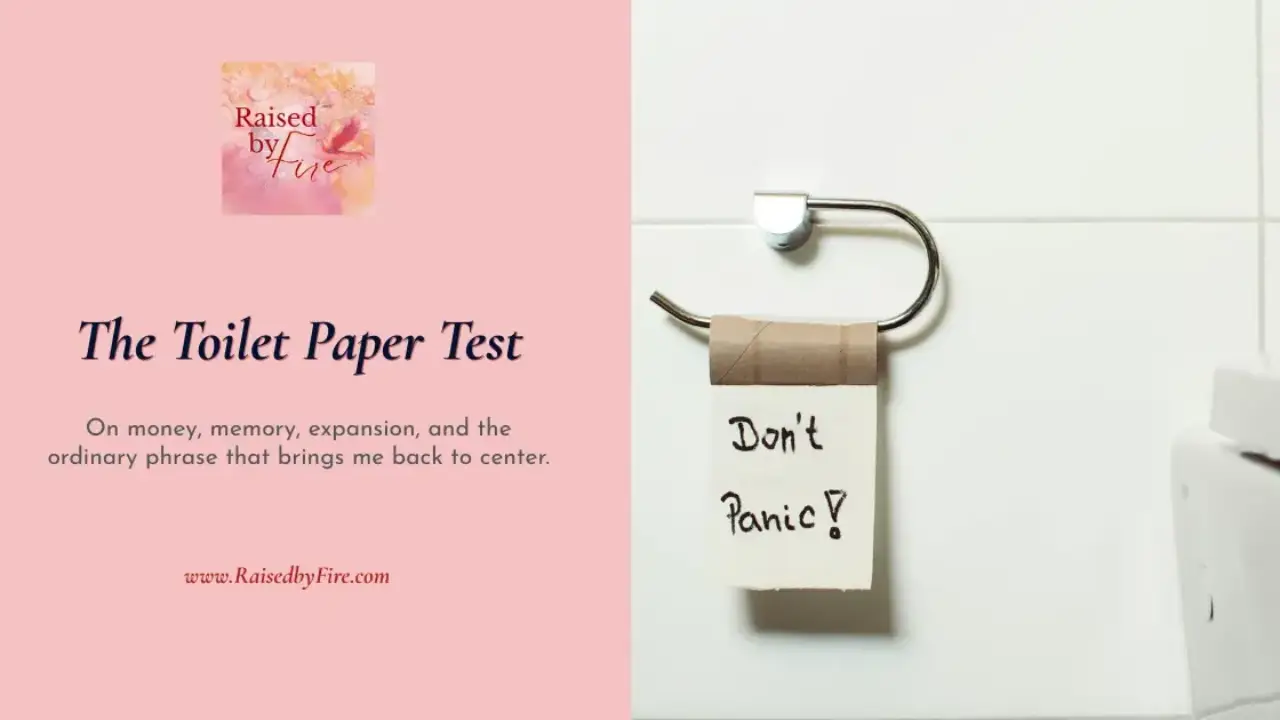
On money, memory, expansion, and the ordinary phrase that brings me back to center.
There are certain memories that do not announce themselves as life lessons while you are living them.
They are too ordinary.
Too inconvenient.
Too embarrassing.
Too immediate.
At the time, they are not symbolic. They are not poetic. They are not material for an essay you will someday write when your life has opened into a different kind of room.
They are simply the thing in front of you.
A bill.
An empty account.
A half-finished plan.
A grocery list you keep editing down.
A roll of toilet paper you do not want to buy because every penny matters.
Years ago, after my divorce, I moved to Nashville.
My divorce was final in November. By January, I was in Tennessee, trying to figure out what came next. I did not have a job. I did not have a clear plan.
I did not have the kind of financial room that lets a person breathe easily while their life is changing shape.
And even though I had lived on my own before—in Atlanta, in Hilton Head, in more than one version of my life—there was something about that season that felt different.
I was not simply living alone.
I was rebuilding alone.
There is a difference.
Living alone can be freedom.
Rebuilding alone can feel like standing in the middle of a room after the walls have come down, trying to decide which pieces are worth keeping and which ones were never yours to carry in the first place.
That season was full of small calculations.
Not dramatic ones.
Survival does not always look dramatic from the outside. Sometimes it looks like sitting in your apartment and deciding whether you can wait another day before buying the thing you need. Sometimes it looks like stretching what is left. Sometimes it looks like convincing yourself you are fine because technically nothing terrible has happened.
And sometimes it looks like using coffee filters for toilet paper because you do not want to spend money on a case of toilet paper.
That is not a sentence I ever imagined writing.
But it is true.
And the truth is, it was not the end of the world.
It was uncomfortable.
It was humbling.
It was not glamorous.
It was certainly not the life I wanted.
But it did not destroy me.
I used coffee filters for toilet paper, and then life went on.
That is the part I have had to remember.
Not as a cute story.
Not as proof of how hard things once were.
Not as a way to perform humility.
As a correction.
Because the body remembers what the mind pretends it has outgrown.
My mind knows that I am not that woman in Nashville anymore. My mind knows that over two decades have passed. My mind knows that I have built, lost, rebuilt, created, carried, endured, imagined, published, moved, started over, and kept going more times than most people will ever see.
But the body does not track time the same way.
The body stores moments.
It stores the feeling of not knowing if there will be enough.
It stores the humiliation of having to make tiny decisions feel enormous.
It stores the strange arithmetic of survival.
It stores the belief that one wrong move might collapse the whole thing.
And when life begins to expand again, when the rooms get bigger, when the vision becomes more visible, when the numbers require capacity, when the work asks to be held at a level no one in your family system ever taught you to trust, that old layer can rise.
It does not always sound like fear.
Sometimes it sounds like responsibility.
Sometimes it sounds like caution.
Sometimes it sounds like wisdom.
Sometimes it sounds like:
Are you sure?
Are you sure you can hold this?
Are you sure you are allowed to want this much?
Are you sure the floor will stay under you if you step into a larger room?
That is the layer I call the “oh shit” layer.
And she can be very convincing. She does not only show up when something scares me. That would be easier to recognize.
She also shows up when something excites me and gets me hopeful.
That is the part people do not always understand about expansion. The nervous system can interpret excitement and fear through the same doorway.
A possibility can be beautiful and still feel threatening to the part of you that learned not to trust good things too quickly.
A door can open and your body can still brace.
A vision can be yours and still feel too large for the old wiring.
A room can be exactly where you are meant to go, and some younger, trained, careful part of you can still whisper:
This is too much.
Slow down.
Do not get ahead of yourself.
Do not need too much.
Do not want too much.
Do not trust this too much.
Do not be humiliated if it does not happen.
Do not be seen wanting something before it arrives.
That last one is its own kind of prison.
The old self will often try to protect you from disappointment by asking you to shrink the desire before the world has a chance to witness it. But shrinking a vision does not make you safer. It only makes the room smaller.
So I needed a way to come back to center. To take the power out of something being too exciting or too overwhelming.
Not a grand mantra.
Not a spiritual performance.
Not a phrase that made the moment more dramatic than it already felt.
I needed something ordinary.
Mundane.
Almost ridiculous.
Something with no glamour in it whatsoever.
So I asked myself, what is a word that will work? This is what immediately came to mind:
Toilet paper.
Yes, toilet paper!
That is the test.
When my mind starts racing too far into excitement or too far into panic, when the old “oh shit” layer starts trying to take over the whole conversation, I bring myself back with the most average phrase imaginable.
Toilet paper.
It does two things immediately.
First, it interrupts the spiral.
You cannot stay too mythic when you say “toilet paper.” You cannot keep building a cathedral of fear around a mundane household item.
It cuts through the emotional theater.
It takes the charge out of the moment.
It brings the whole thing back down to earth.
Second, it reminds me of the coffee filter season.
Not to shame me.
Not to scare me.
To steady me.
Because twenty-six years later, the thing that once felt so loaded did not end me. I got through it just fine.
I am here.
Life is good.
All is well.
That is the sentence underneath the sentence.
Toilet paper means:
Come back to the middle.
Do not fly too high on excitement.
Do not collapse too low into panic.
Do not make this bigger than it is.
Do not give the old fear permission to narrate the new room.
You have survived far harder things than this moment.
You are not in Nashville with no job and no margin.
And even when you were, you made it through.
That is the strange mercy of memory when it is metabolized.
The same memory that once carried shame can become a stabilizer. The same moment that once represented lack can become evidence. The same ordinary object that once felt like a financial decision can become a private code for safety and neutrality.
This is part of what I mean when I talk about becoming.
It is not always dramatic.
Sometimes becoming is learning how to regulate the part of you that was trained to expect collapse. Sometimes it is noticing that your fear is not responding to the present moment, but to an old room. Sometimes it is refusing to let family history, inherited limitation, or survival memory decide what level of life you are allowed to occupy now. Sometimes it is looking at a vision that is bigger than what you were taught to trust and saying:
I do not need to shrink this to make my body feel safe. I need to bring my body with me.
That is different.
For a long time, I thought the answer was to override the fear.
Push harder.
Prove more.
Outrun the old story.
But I do not believe that anymore.
The fear does not need to be humiliated.
It needs to be updated.
It needs to be told:
Thank you for trying to protect me.
But this is not that.
This is not the apartment in Nashville.
This is not the coffee filter moment.
This is not the season when every penny had to be argued with.
This is not proof that wanting more will punish me.
This is a new room.
And I am allowed to enter it without dragging every old emergency across the threshold.
That is why my “toilet paper” phrase works.
It is not magical.
It is not profound.
It is not elegant.
It is toilet paper.
And sometimes the most ordinary thing in the room is the thing that brings you back to yourself.
I have been thinking a lot lately about the behemoth of family history.
Not family as a concept.
Family as weight.
Family as expectation.
Family as a ceiling no one calls a ceiling because everyone has learned to decorate it.
Family as the inherited instruction to stay close to what is known, even when what is known has been too small for your life for a very long time.
When you begin removing that weight from your back, the first sensation is not always freedom.
Sometimes the first sensation is exposure.
If I am no longer carrying what was handed to me, who am I? If I am no longer organizing my life around their fear, what size is my life allowed to become? If I am no longer waiting for permission, what happens when the door actually opens?
Those are not small questions.
And they do not always arrive gently.
Sometimes they arrive in the middle of building something real.
A book.
A platform.
A new public life.
A larger vision.
A room your younger self could not have imagined, because no one around her had language for it.
That is when the old nervous system tries to help by pulling out its file of past emergencies.
It says:
Remember when there was not enough?
Remember when you were alone?
Remember when you had to figure it out?
Remember how humiliating that felt?
And I say:
Yes. I remember. I remember all of it.
And I also remember that I lived.
I remember that the coffee filters did not become the whole story.
I remember that lack was a season, not an identity.
I remember that a woman can be humbled without being ruined.
I remember that the middle is not mediocrity.
The middle is steadiness. The middle is where I can receive without floating away and respond without collapsing. The middle is where I can build.
That is what The Toilet Paper Test gives me.
It brings me back to the middle.
It reminds me that the old panic is allowed to have a voice, but it does not get the keys. It reminds me that excitement does not require acceleration.
Fear does not require retreat.
And expansion does not require me to abandon the body that carried me here.
I can want the larger life.
I can prepare for the larger room.
I can allow the work to be seen.
I can let the book leave my hands.
I can let people enter the story.
I can let support arrive.
I can let good things be good without immediately scanning the room for what might go wrong.
And when the old layer rises, as it sometimes does, I can say the most unromantic thing possible.
Toilet paper.
Come back.
Breathe.
You are not there anymore.
And even when you were there, you made it through.
There is another story from that season I have not told here yet.
It involves my marriage, my divorce, and one of the clearest editorial decisions I made while writing Raised by Fire: why that part of my life shaped the woman who wrote the book, but did not belong at the center of the book itself.
Not every true thing belongs in the manuscript.
Some truths are lived, metabolized, and allowed to remain outside the spine.
I’ll be sharing more about that privately with Founding Insiders—the readers who have chosen to enter the closer room behind Raised by Fire.
Inside Raised by Fire
Book release updates, Love Lounge episodes, and what’s unfolding next.
We hate SPAM. We will never sell your information, for any reason.
